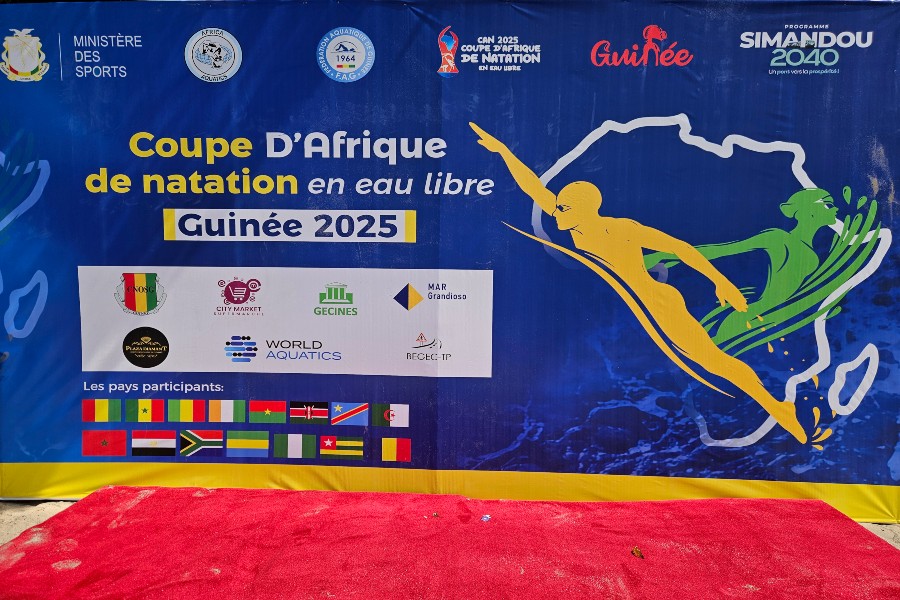
Conakry, birthplace of the Cup, stages the decisive second leg of the 2026 circuit, where the season's points are totalled, the first continental champions are crowned, and USD 3,750 in overall prize money is added to a weekend already worth USD 1,000 per event win
CONAKRY, Guinea – 9 September 2026 – The Africa Aquatics Open Water Swimming Cup was launched in Guinea. In November, it comes home to be decided there. The third edition of the Cup, on 21 and 22 November 2026, is the second and final stage of the 2026 circuit, and it carries a weight no previous edition has held: when the last swimmer touches the finish, the season's points are added up and Africa names its first Open Water Swimming Cup Champions.
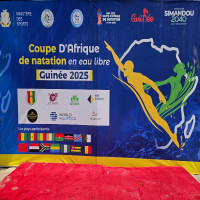
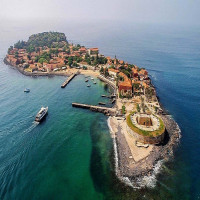
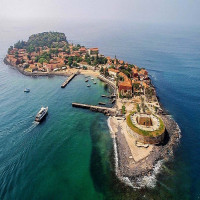
Guinea has earned the right to host that moment. The Fédération Aquatique de Guinée staged the inaugural Cup on Sorro Island from 28 to 30 November 2025, proving that a continental open water competition could be run on Guinea's Atlantic coast and drawing federations from across Africa to a venue few of them had raced before. The 2026 return is both a reward for that first edition and a test of what the circuit has become.
The stage where the title is decided
The 2026 circuit has two legs. Senegal opens it on 25–27 September; Guinea closes it eight weeks later. Points from the 5 km and the 3 km Sprint accumulate across both stages on a scale of 18 for a win, then 16, 14, 12, 10, 8, 6, 5, 4, 3, 2 and 1 down to twelfth place. Only swimmers who race both stages count in the final standings, so the field in Conakry will be made up of athletes who have already laid down a marker in Senegal, and every one of them will arrive knowing exactly what they need.
The regulations make Guinea the kingmaker. If two swimmers finish the circuit on equal points, the first tie-break is their placing at the second stage. The second is the number of victories over the circuit, the third the better result over the longest distance. A swimmer who came second twice in Senegal can still take the title by winning in Guinea. A swimmer who dominated Senegal cannot afford a slip on the final weekend.
The overall prizes are decided and presented in Conakry: USD 1,500 for the men's and women's circuit champions, USD 1,250 for second and USD 1,000 for third, in addition to the stage prize money and the official titles of 2026 Africa Aquatics Open Water Swimming Cup Champion (Men) and (Women).
Two days, five races, one knockout
The Guinea programme follows the fixed format of every Cup stage: men's and women's 5 km, men's and women's 3 km Sprint, and the 4 x 500m mixed relay, compressed into two competition days.
The 5 km is the classic distance and the longest race of the circuit, which also makes it the third tie-break for the title. The 3 km Sprint is anything but classic. It is swum as one competition in three knockout rounds: every entrant races 1,500m in the opening round, the qualifiers go again over 1,000m, and the finalists settle the medals over 500m. The number of swimmers advancing from each round is fixed at the Technical Meeting according to the size of the entry. With a circuit title potentially riding on a 500m final, it may be the most dramatic ten minutes of the African open water year. Last November it produced the two performances of the Cup: Egypt's Mohamed Moselhy won every round of the men's event, taking the final in 6:14.53, and South Africa's Callan Lötter did the same in the women's, finishing in 6:02.4.
The mixed relay, 4 x 500m in the 2026 format, closes the programme. Teams may combine swimmers from different Member Federations, an arrangement that lets smaller delegations join forces and race for the largest single prize of the weekend: USD 1,500 for the winning quartet, USD 1,000 for second and USD 750 for third. It is also the event in which the hosts have a medal to defend: Guinea's quartet of Fodé Amara Camara, Mohamed Hady Fofana, Mariama Lamaranah Touré and Marie Mebelle Camara took silver behind South Africa in 2025, with Mali third. Individual events pay USD 1,000, USD 750 and USD 500 to the top three, with gold, silver and bronze medals in every race. Medallists must attend the Victory Ceremony properly dressed or forfeit their medal.
What Conakry 2025 left behind
The inaugural Cup drew swimmers from thirteen Member Federations and was decided by two athletes. Moselhy won the men's 5 km in 1:01:32 by three seconds from Sven van der Linde, with Senegal's Amadou Ndiaye third, then beat the same two men in the 3 km Sprint final. Lötter won the women's 5 km in 1:02:46 and the Sprint final ahead of compatriot Hannah Neilson on both occasions, then anchored South Africa's relay to victory in 25:33.6. South Africa left Conakry with three golds and four silvers; Egypt with two golds; Senegal with two bronzes; Morocco, through Miniya Aya's third place in the women's Sprint, with one.
The other lesson of the first edition was attrition. Nine of the nineteen men's 5 km starters missed the time limit and six did not finish; in the women's 5 km only two of nine were classified. Guinea's own swimmers were among those who fell short over the long distance, and the domestic season since has been about closing that gap before the Cup returns.
Entries: two deadlines, not one
Guinea's entry process runs in two steps, and federations should diarise both.
Provisional entries, stating the number of swimmers, coaches and Technical Officials, must reach the Organising Committee and the Secretary General of Africa Aquatics by 15 October 2026. Final entries, with the names of every swimmer, coach and official, are due by 10 November 2026, eleven days before racing.
All competitors must be citizens of the Member Federation they represent and must present their passports for nationality verification no later than the Team Leaders' Meeting. Only federations in good financial standing with Africa Aquatics may enter. There is no cap on the number of swimmers a federation may enter per event.
The Technical Meeting for team leaders and the meeting of appointed Technical Officials both take place 24 hours before the first race, and attendance is mandatory. Withdrawals after the Team Leaders' Meeting carry a USD 200 fine per swimmer and USD 400 per relay team unless the Competition Doctor issues a medical certificate. Protests go to the Referee in writing, on the official Africa Aquatics form, within 30 minutes of the event, with a USD 200 deposit.
Guinea's second act
When Africa Aquatics announced the inaugural Cup in October 2025, it described the Conakry event as the first step toward a circuit spanning the continent's zones. Thirteen months later, Guinea is no longer the whole competition but its climax, and the Fédération Aquatique de Guinée has used the interval to keep building, with domestic open water activity organised in the run-up to November. For the swimmers, Conakry offers something rare in African open water: a venue with a competition history, a host that has done this before, and a title that will not be settled anywhere else.
The circuit begins in Senegal in sixteen days. It ends in Guinea, where it started.
Key facts: Guinea 2026
| Item | Detail |
|---|---|
| Edition | 3rd edition of the Cup, 2nd and final stage of the 2026 circuit |
| Dates | 21–22 November 2026 |
| Events | Men's and Women's 5 km, Men's and Women's 3 km Sprint, 4 x 500m Mixed Relay |
| Stage prize money, individual | USD 1,000 / 750 / 500 |
| Stage prize money, mixed relay | USD 1,500 / 1,000 / 750 |
| Circuit prize money, overall | USD 1,500 / 1,250 / 1,000 (men and women) |
| Circuit points | 18, 16, 14, 12, 10, 8, 6, 5, 4, 3, 2, 1 |
| Provisional entries deadline | 15 October 2026 |
| Final entries deadline | 10 November 2026 |
| Tie-break order | Placing in Guinea, then number of wins, then best result over the longest distance |
| Inaugural champions (Conakry 2025) | Mohamed Moselhy (EGY) and Callan Lötter (RSA), 5 km and 3 km Sprint; South Africa, mixed relay; Guinea, relay silver |
| Previous stage | Senegal, 25–27 September 2026 |